A cold air intake is usually the first mod anyone buys, and the one with the most myths attached. It does not add 30 horsepower to a four-cylinder. It does not improve your gas mileage. It will not void your warranty by itself, and in California it may not be legal at all.
What a cold air intake actually does is smaller and more specific than the marketing. This guide uses real dyno data, the government's own fuel economy guidance, and the California rules most guides skip, to answer the questions people actually search: what it does, how much power, MPG, warranty, legality, cost, and whether it's worth it.
What does a cold air intake do?
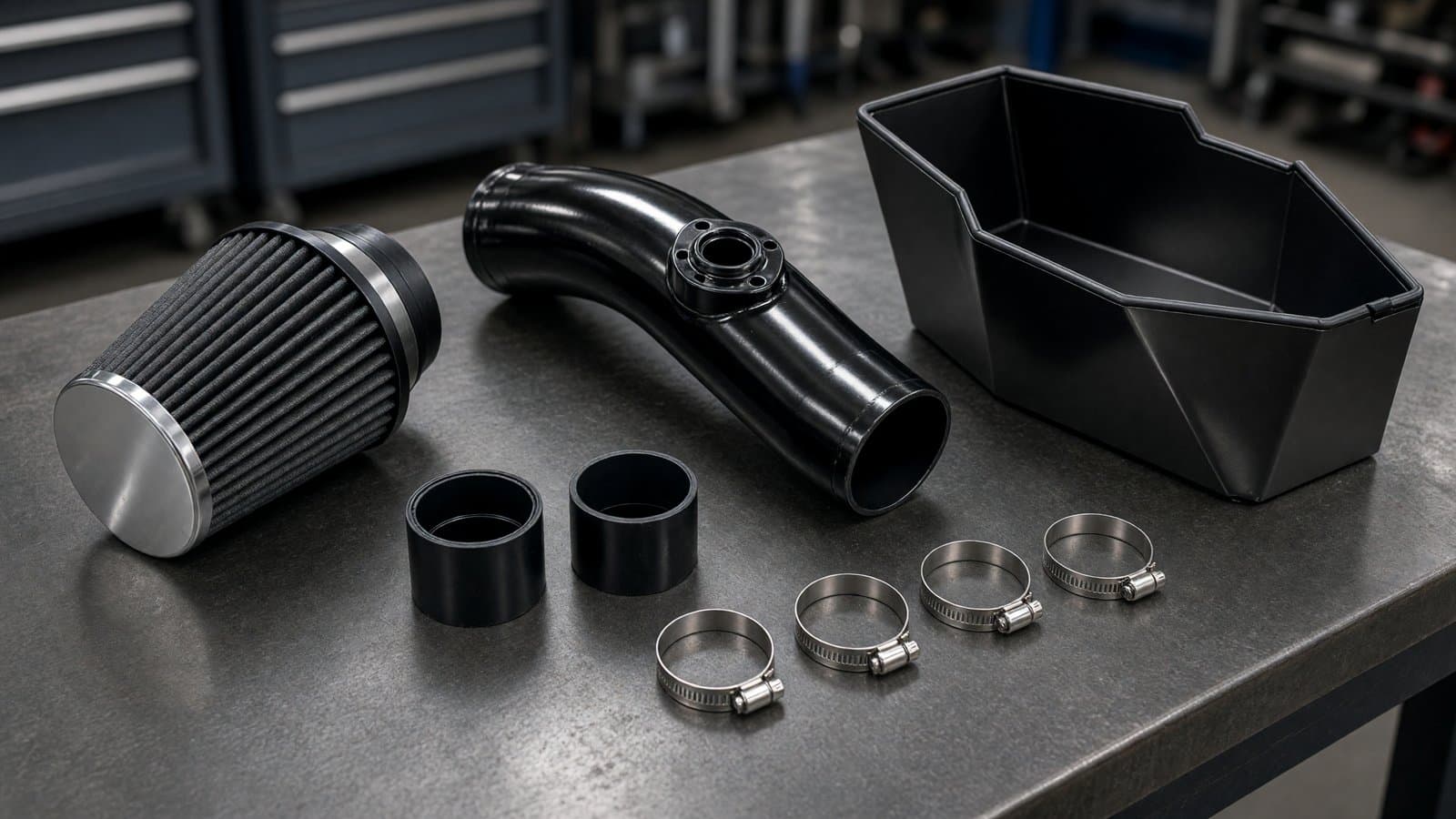
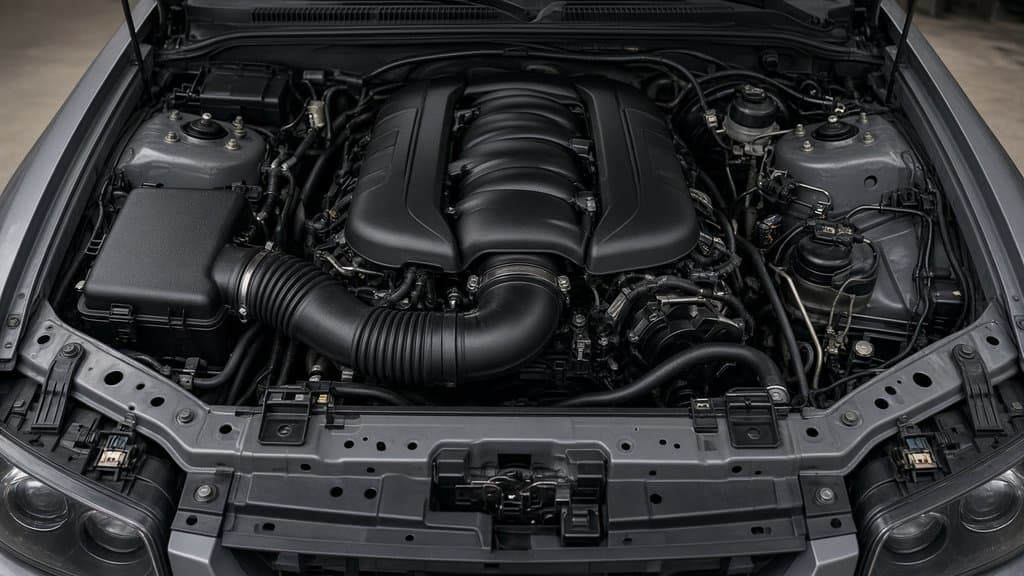
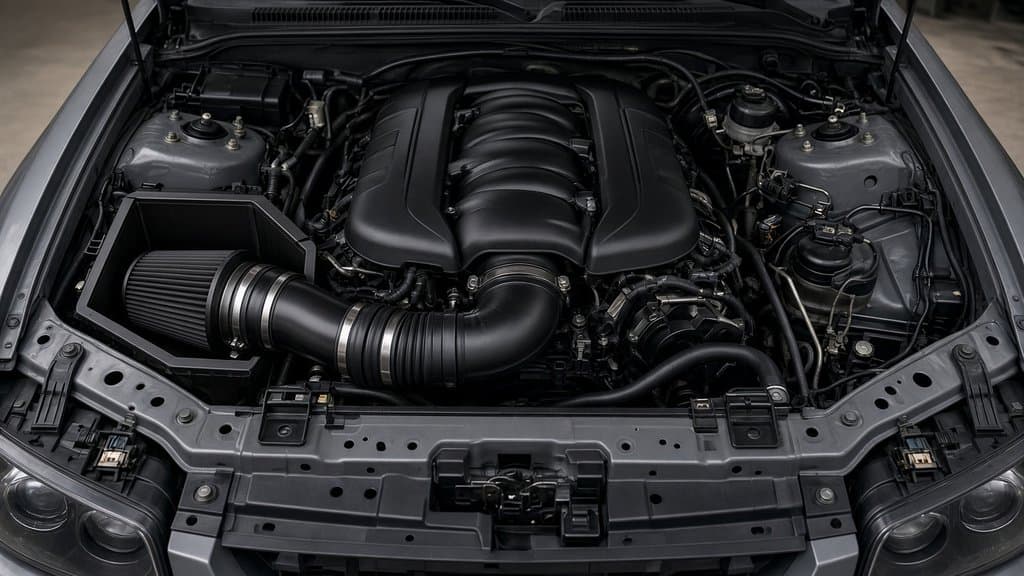
It replaces the factory airbox with a freer-breathing filter and tube. California's air regulator describes a typical kit in its approval paperwork as an "open-element reusable air filter, intake system tubing, assorted brackets, and hardware" that replaces the stock air box (CARB Executive Order D-269-63, 2019). Most kits add a heat shield around the filter to keep engine heat away from it.
Is the air actually colder?
Often not by much. The bigger gain is less restriction. When Mishimoto developed its intake for the 2015 Mustang GT, it logged the factory system first and found intake air averaging 95.8°F against 89.2°F outside, a gap of just 6.6°F. The factory airbox wasn't pulling much hot air to begin with. What the aftermarket intake changed was flow: Mishimoto's flow bench showed a 47% cut in pressure drop. On its 2024 Tacoma intake, the headline figure is the same kind: up to 27.7% less intake restriction.
So think of a "cold air intake" as a low-restriction intake. Cooler air helps when you get it, but the name promises more than the thermometer shows.
How much horsepower does a cold air intake add?
About 4 to 19 horsepower on a stock tune, and the engine decides which end you get. Here are measured and published gains from one manufacturer that shows its work, all on the factory ECU calibration:
Sources: Mishimoto product pages for the Civic Si, GTI, and Civic Type R, and its engineering posts for the BRZ, Tacoma, and Mustang GT. Mixed units (wheel horsepower vs. horsepower) are as each source reported them.
Three details from those tests matter more than the peak numbers:
- Peak isn't typical. The BRZ intake peaked at 7 whp near 7,000 rpm but delivered only 2-4 whp across most of the rev range.
- The first pull lies. The Mustang GT showed about 30 hp on early dyno runs, then settled at about 19 hp and 23 lb-ft after the ECU relearned over hundreds of miles. If a video shows a huge gain right after install, that may be why.
- Big gains come with a tune. Ford's own Mustang GT intake bundle pairs the intake with a calibration and a larger throttle body for +19 hp at 6,500 rpm and +42 lb-ft at 2,000 rpm. The automaker itself treats the intake as one part of a tuned package.
We couldn't find an independent magazine dyno test that loads, so these are manufacturer numbers. Mishimoto's are unusually transparent, with test conditions and full curves, which is why we used them.
Do you need a tune with a cold air intake?
Not for most bolt-on kits, but it depends on the MAF sensor housing. Most engines measure incoming air with a mass airflow (MAF) sensor, a heated element that reports airflow as a voltage. Mishimoto explains that enlarging the housing around that sensor "can hurt the sensor's resolution," and a badly designed intake can cause check engine lights or even a no-start from skewed fuel trims. That's why no-tune kits keep a factory-size MAF housing.
Race kits don't. Mishimoto's Civic Type R race intake uses an 82mm MAF housing and requires a custom tune. If you're planning a tune anyway, the intake belongs in that conversation; our ECU tune guide and stage 2 guide cover how the parts fit together.
Does a cold air intake increase MPG?
No. The government's fuel economy site is direct about it: on fuel-injected, computer-controlled gasoline engines, replacing a clogged air filter "does not improve fuel economy, but it can improve acceleration". The engine computer meters fuel to the air it measures, so more airflow means more fuel, not free miles.
The FTC adds broader context: the EPA has evaluated or tested more than 100 alleged gas-saving devices and "has not found any product that significantly improves gas mileage." Any intake sold on an MPG promise is selling something the data doesn't support.
Does a cold air intake void your warranty?
Not on its own. Damage it causes is a different story. The FTC says "your warranty stays in effect if you use aftermarket or recycled parts," and the manufacturer or dealer "must prove the aftermarket or recycled part caused the damage before they can deny warranty coverage." Federal law also bars making a warranty conditional on brand-name parts (15 U.S.C. § 2302(c)).
The real trap is oil. GM's service bulletin 04-07-30-013E (June 2023) tells technicians that oil from an excessively over-oiled aftermarket filter can contaminate the MAF sensor, causing check engine lights, harsh or slipping shifts, stumbling, and rough idle, and that those problems "are not considered to be warrantable repair items." So the intake doesn't void anything, but a sloppy re-oil can cost you a transmission repair. SEMA notes dealers still deny claims without written explanations, so keep receipts and ask for any denial in writing.
Is a cold air intake legal?
In California, only with a CARB Executive Order. Shops are on the hook too. CARB's Enforcement Advisory 292 (July 2020) lists air intakes among performance parts that "typically require an exemption... (known as a CARB Executive Order (EO))" to be legally advertised, sold, installed, or used in California. The advisory spells out what that means:
- A "for racing only" label is no defense: selling or installing without an EO is a violation "regardless of any real or claimed intent."
- Penalties run up to $37,500 per violation.
- Shops that install parts without an EO must keep records for four years.
Many kits carry an EO: Mishimoto's Civic Si and Type R intakes list EO D-759-25, and Ford's Mustang GT bundle is sold as 50-state emissions legal under EO D-752-18. Others don't: aFe's Momentum GT intake for the 2021-2025 F-150 3.5 EcoBoost is listed as not CARB exempt and not available in California. Check the product page for the EO number, or search CARB's database.
One catch for tuners: CARB's EOs for intakes are valid only if the kit's instructions don't recommend tuning the engine beyond factory specifications. An EO-approved intake plus an unapproved tune is no longer an approved setup.
Risks: hydrolock, oil, and fuel trims
- Hydrolock: a filter mounted low in the fender or bumper can suck in water in deep standing water, and water doesn't compress. AEM patented a bypass valve for exactly this case, which opens when the filter is blocked.
- Over-oiling: the GM bulletin above. Follow the oil instructions exactly; more is not better.
- Fuel trims and check engine lights: from a MAF housing that doesn't match the factory calibration. Stick to no-tune kits unless you're tuning.
How much does a cold air intake cost?
Most bolt-on kits run about $360 to $550. Tuned packages cost more. Prices observed October 2026:
| Kit | Vehicle | Price | California EO |
|---|---|---|---|
| Mishimoto Performance Intake | 2017-2020 Civic Si | $359 | D-759-25 |
| Mishimoto Performance Intake | 2015-2021 VW GTI / Golf R | $428 | not listed |
| Mishimoto Performance Intake, dry filter | 2018-2023 Wrangler JL 2.0 | $429 | D-759-9 (2018-20) |
| aFe Momentum GT | 2021-2025 F-150 3.5 EcoBoost | $420 sale ($552 list) | none |
| Mishimoto Performance Intake | 2017-2021 Civic Type R | $490 | D-759-25 |
| Ford Performance intake + calibration + throttle body | 2018-2021 Mustang GT | $1,535 | D-752-18 |
Most are about an hour of bolt-on work: Mishimoto rates its kits as easy installs and says the GTI kit goes in within an hour without removing the bumper.
Oiled vs. dry filters
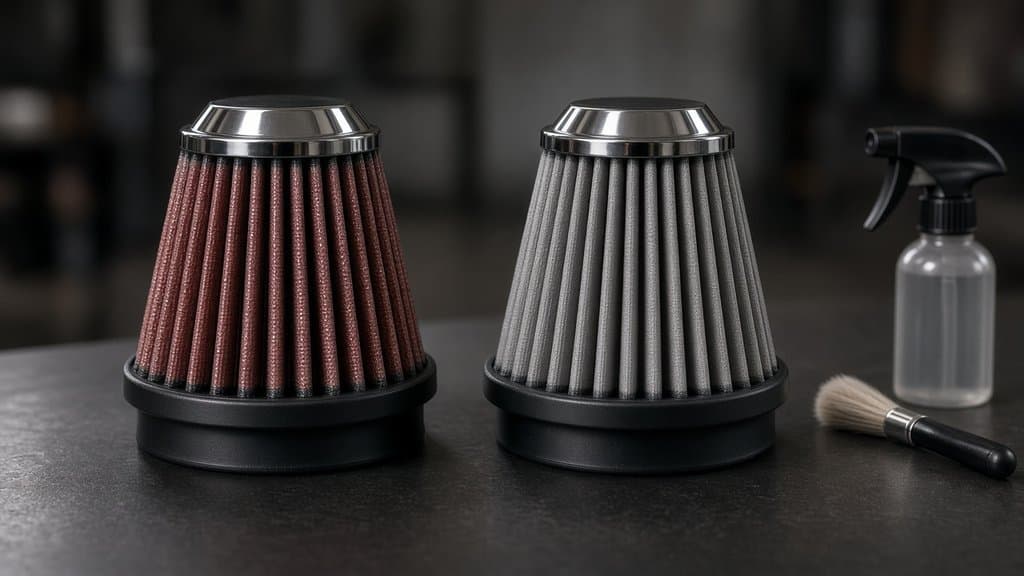
Oiled filters need re-oiling; dry ones just need washing. Service intervals vary a lot by brand. K&N's instructions recommend cleaning its oiled filters "every 50,000 miles" depending on conditions. Mishimoto says to clean and re-oil its oiled filters every 10,000 to 15,000 miles in normal driving, and offers dry washable filters on some kits. Dusty roads and off-roading shorten both. Given the GM bulletin, a dry filter is the low-risk choice if you don't want to think about oil.
Is a cold air intake worth it?
Worth it for sound, response, and as the first step of a tuned build. Not worth it for MPG or big power on its own.
- Worth it: you like a louder induction sound, you have a V8 or a larger engine where gains reach the teens, or you're planning a tune and want the intake in place.
- Skip it: you want better fuel economy, you have a small naturally aspirated four-cylinder where the gain is a few horsepower, or you're in California and the kit has no EO.
The mods people actually see
An intake is a mod you hear and feel but nobody sees with the hood closed. The upgrades that change how a car looks are the ones that benefit from a preview: exhaust tips, caliper colors, and wheels. Upload one photo of your car to VizTunr's free demo and see them rendered on it in about a minute. Tuning shops use the same virtual try-on so customers can see the visible half of a build before they book the whole thing. No account needed.
TuningCold Air IntakeEngine ModsHorsepower
October 7, 2026 · 12 min readCategory: Tuning
Explore related