
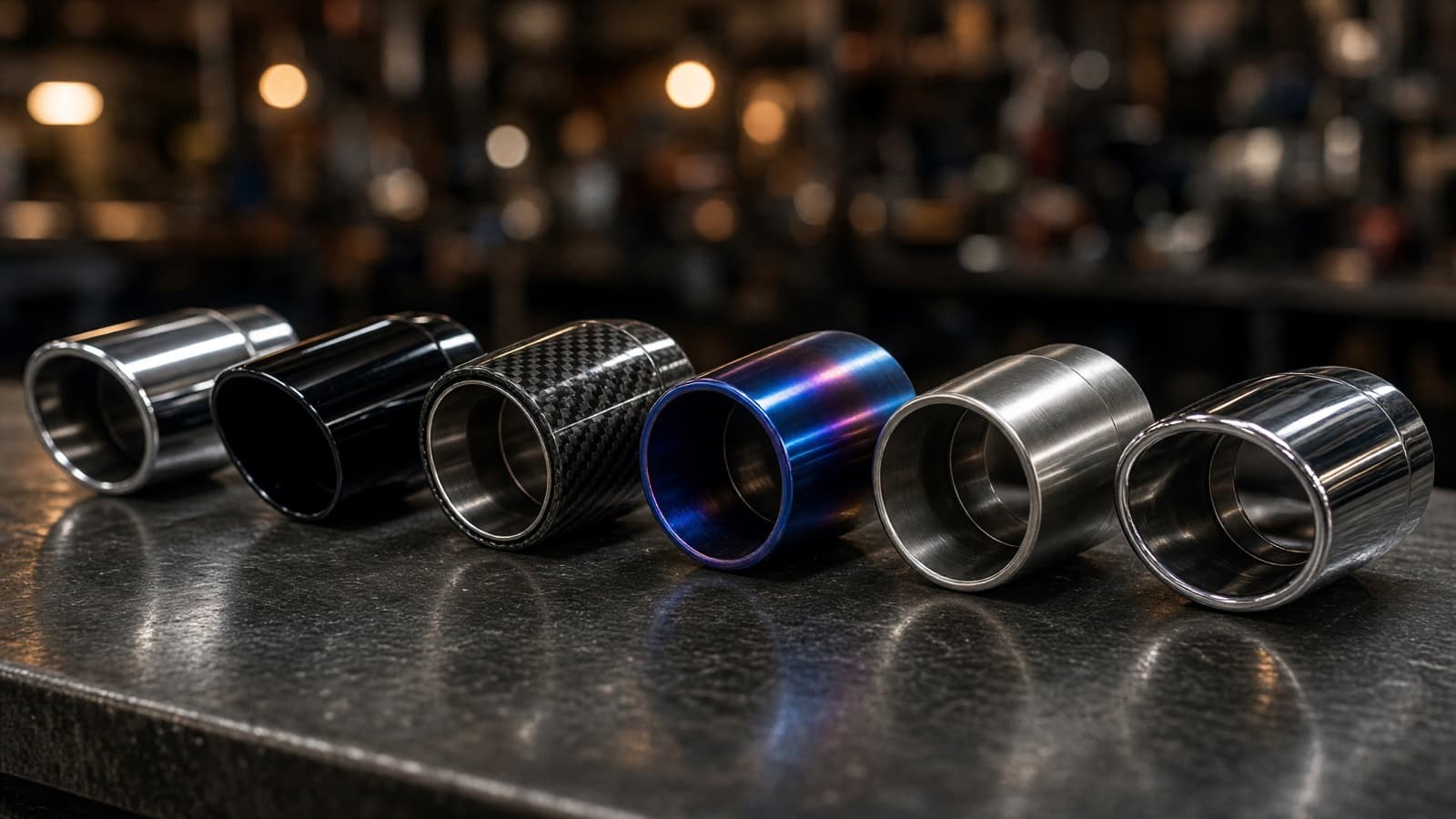
Exhaust tips are the cheapest way to change how the back of your car looks, and the easiest mod to get wrong. The internet will tell you they transform the sound (barely), that bigger is better (until it melts your bumper), and that any tip fits any pipe (it doesn't).
This guide sorts it out: what exhaust tips actually do, what is claimed versus proven about sound, every style and finish worth knowing, how to size one so it fits the first time, what they cost in 2026, and what the law cares about. The finishes are shown on the same car, from the same angle, so you can compare the thing that matters: the look.
What do exhaust tips do?
They finish the rear of the car. That's the job. An exhaust tip is a decorative sleeve that clamps or welds over the end of the tailpipe, replacing a plain cut pipe with a shaped, finished outlet. CarParts.com's guide (updated May 2025) lists the benefits in honest order: looks first, then some heat dissipation, then minor personalization of the exhaust note.
What tips don't do is add power. They sit at the very end of the system, after every part that shapes flow. If you want performance, that conversation starts with the parts a stage 2 tune asks for, not with the last six inches of pipe.
That doesn't make tips trivial. People care: when we pulled Ahrefs data in September 2026, "exhaust tips" drew about 7,200 US searches a month, with "dual exhaust tips" at 1,700, "black exhaust tips" at 1,100, and "chrome exhaust tips" at 1,000. It's a small part that sits exactly where everyone behind you is looking.
Do exhaust tips change sound?
A little, in tone rather than volume - and nobody has published measurements. CarParts.com puts it plainly: a tip "won't be louder, but it may sound deeper," and the muffler and resonator matter far more. The shape-to-sound claims that retailers agree on:
| Tip feature | Claimed effect | Who says so |
|---|---|---|
| Wider outlet | Deeper, throatier tone | CarParts.com, MAPerformance |
| Narrower outlet | Raspier, thinner tone | CarParts.com, MAPerformance |
| Longer tip | Quieter, fewer high frequencies | CarParts.com, MAPerformance |
| Turn-down tip | Aims sound at the ground | CarParts.com |
| Resonated tip | Softens rasp and harshness | MAPerformance, SPELAB |
| Single vs. double wall | "A cosmetic styling preference," not a sound one | MAPerformance |
Here's the part other guides skip: none of these sources publishes a decibel reading or a frequency plot. They are retailers and parts makers repeating the same workshop wisdom. It's plausible wisdom - SPELAB's July 2026 guide sums it up as tips changing "tone more than volume," and only subtly - but it is not test data.
So buy a tip for how it looks. If you want a different sound, you're shopping for a muffler, a resonator, or a cat-back system. If a product page promises an aggressive new exhaust note from a clamp-on tip alone, that's marketing.
Exhaust tip styles: single, dual, quad, and the cuts
Style comes down to three choices: how many outlets, what shape, and how the end is cut.
Count. A single tip per side is the clean default. Dual exhaust tips split one inlet into two outlets through a Y-shaped body - Corsa, for example, lists a twin 4-inch tip on a 3-inch Y-inlet. Quad setups put a pair on each side and read as "performance model" because that's where automakers use them.
Shape. MagnaFlow's catalog sorts tips into round, oval, and rectangle bodies. Round suits almost anything; oval and rectangular tips fill wide bumper cutouts that would swallow a round one.
Wall and edge. Fabricator DarkLight's style guide (June 2025) covers the vocabulary:
- Single wall: one layer of stainless. Simple, light, budget-friendly, a raw motorsport look.
- Double wall: two layers of metal with a thicker, more finished face that handles heat better. The OEM-plus choice.
- Rolled edge: the lip curls into a rounded rim. Softer and more factory-looking.
- Slash cut: the end is cut on a steep diagonal for an aggressive, race-car look. An angle cut is the subtler version of the same idea.
- Straight cut: squared off, flush, and understated.
- Turn-down: the outlet points at the ground, hiding the tip and aiming the sound downward.
Whatever you choose, symmetry is what makes it look right. Tips that sit level, evenly spaced, and at the same depth in the bumper look factory. Tips that droop look like an afterthought, whatever they cost.
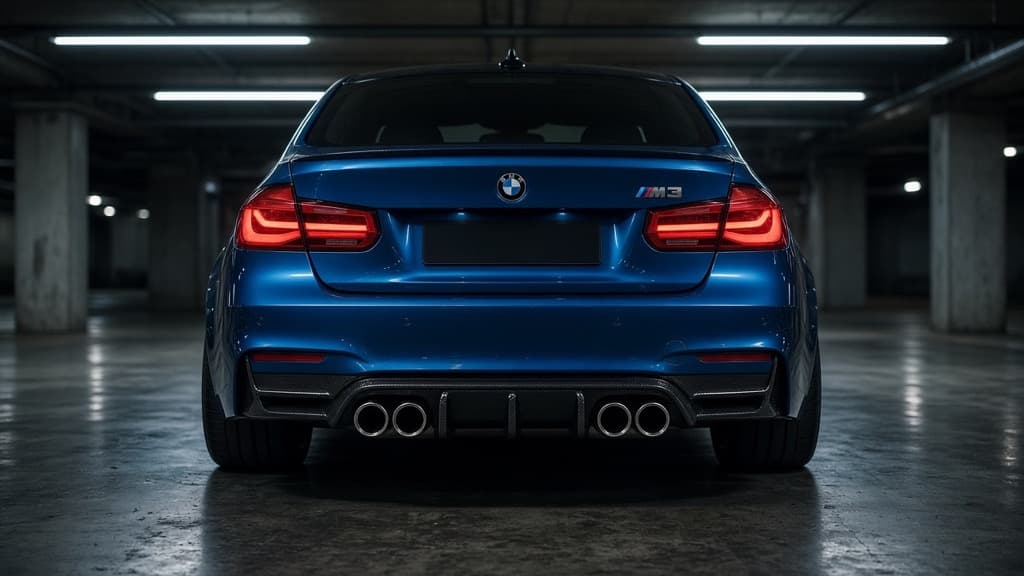
Exhaust tip finishes: chrome, black, carbon fiber, burnt titanium
The finish is what you see, but the metal underneath is what you live with. Start there. Nameless Performance explains the two stainless grades (February 2026): T409 has less nickel and chromium than T304 and "tends to rust on the surface over time," though usually only cosmetically. The field test is a magnet - it sticks to 409 and barely grabs 304. Cheaper still is chrome-plated steel, which Gexhaust's truck guide (December 2024) says "requires frequent maintenance."
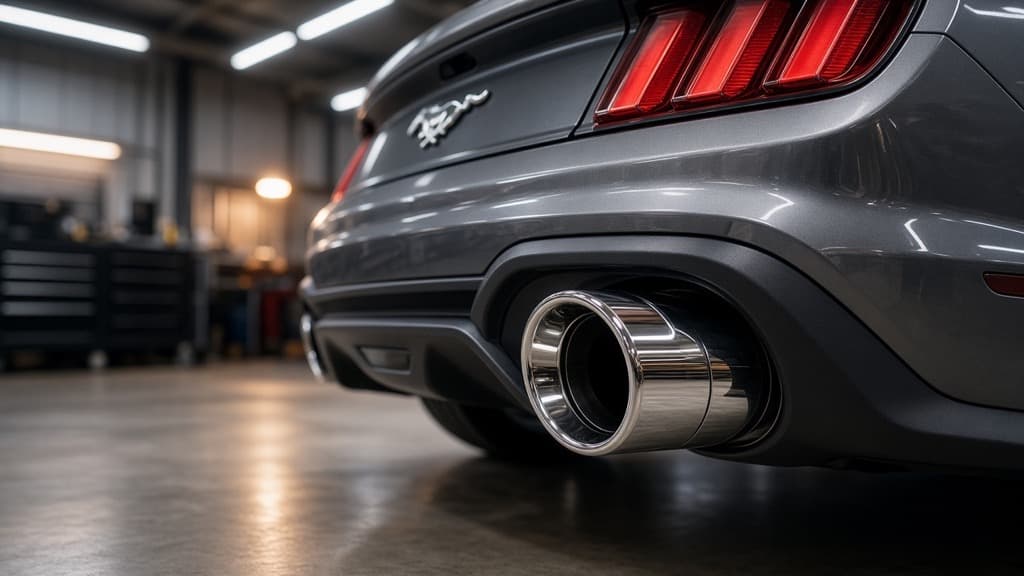
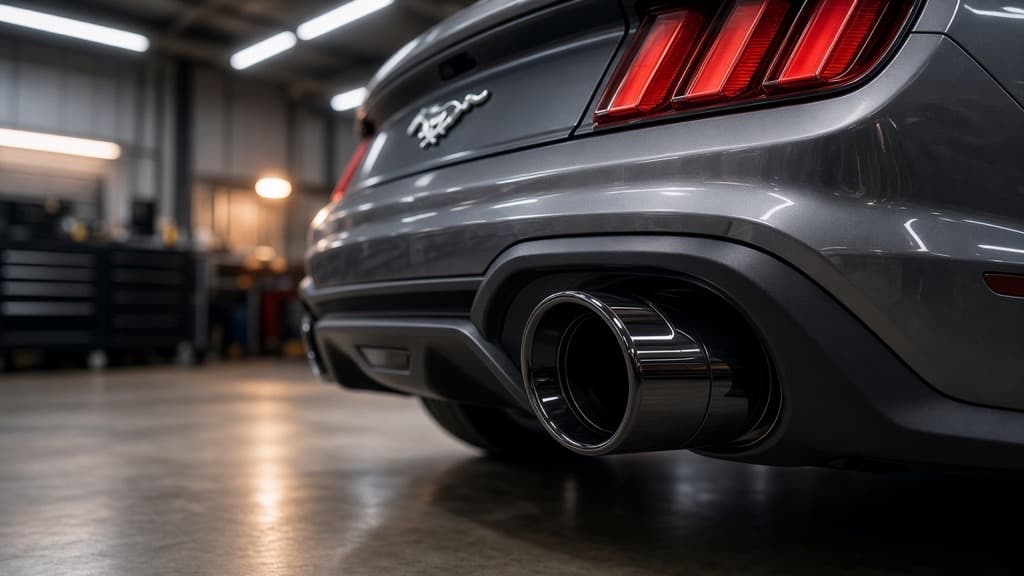
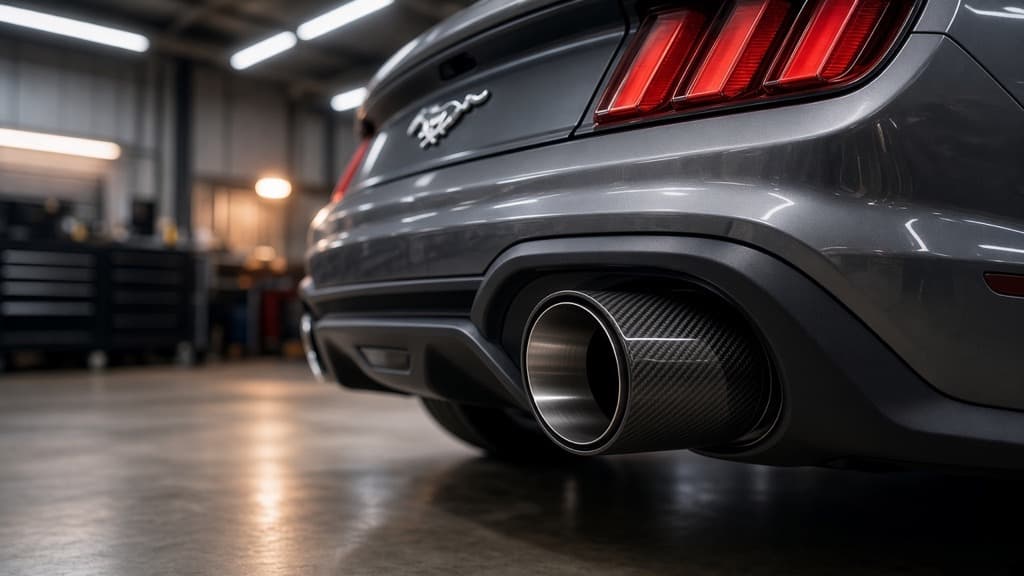
Below: the same Mustang GT, same angle, same light, four finishes.
Chrome and polished stainless exhaust tips
The classic. Mirror-bright, matches factory brightwork, and suits almost any color. Polished T304 can take a chrome-like shine and keeps it with an occasional pass of metal polish. The cost is visibility: every water spot and soot ring shows.
Black exhaust tips
Now the more-searched finish, narrowly. Black disappears into a dark valance or diffuser and makes the rear look lower and wider. The coatings vary: Corsa uses black PVD over dual-wall 304 stainless, MagnaFlow a "thermal-resistant" black coating, XFORCE a matte black over stainless. Black also hides soot, which is the whole reason it rules the diesel world (more on that below).
Carbon fiber exhaust tips
A carbon fiber tip is a carbon sleeve over a metal tip, not a carbon pipe. MBRP's T5170CF is typical: a carbon fiber outer wall around a mirror-polished T304 inner sleeve. You get the weave on the outside and stainless where the hot gas actually flows. It pairs naturally with a carbon diffuser or the aero on a wide body kit.
Burnt titanium exhaust tips
The gold-to-purple-to-blue gradient comes from heat coloring, and it's the loudest finish you can buy. One thing to know before you pay for it: "burnt" describes the color, not always the metal. XFORCE, for instance, sells a "burnt blue look" on stainless steel. Real titanium handles heat best and costs accordingly; a burnt finish on 304 gets you the look for far less. Read the material line on the product page, not just the photo.
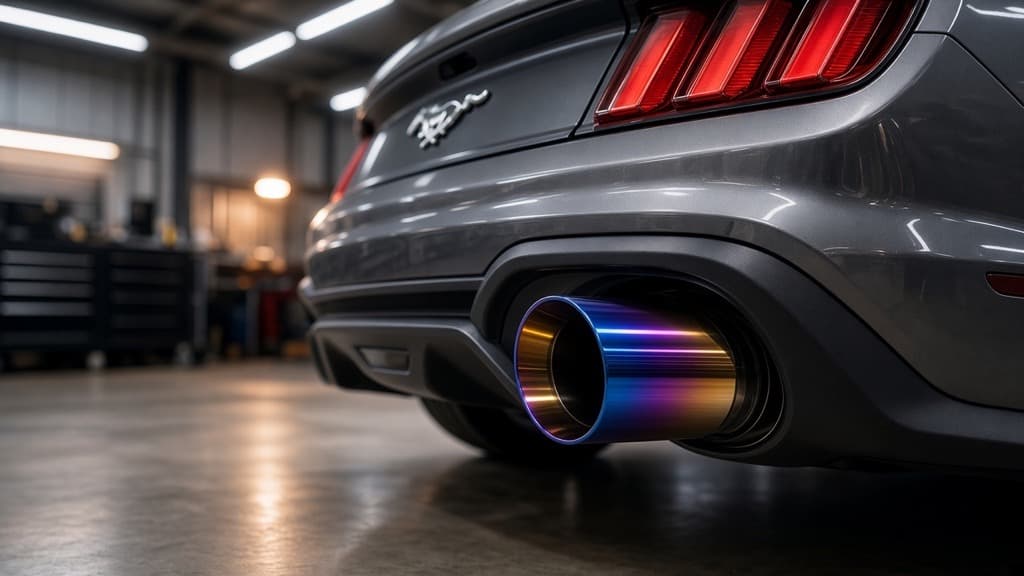
Same car, same tip size, four different rear ends. Chrome reads classic muscle, black reads stealth, carbon reads track build, burnt titanium reads tuner. None of that shows up on a product page with a white background.
What size exhaust tip do you need?
Match the inlet to your tailpipe's outside diameter. The outlet is just styling. A tip has three measurements, and only one of them decides whether it fits:
SPELAB's sizing guide (September 2026) has the method: measure the outside diameter of the tailpipe with calipers on a cool, clean, round section, take two readings to catch an oval or dented pipe, and don't round to the nearest nominal size. On a tip sold as "4 in, 6 out," the 4 is what meets your pipe - and a 4-inch inlet is too loose on a 3.5-inch pipe.
Typical ranges, from the retailers that publish them:
| Vehicle | Typical pipe or inlet | Common outlet |
|---|---|---|
| Cars (universal tips) | 2 to 3 inch inlets (Vibrant, Corsa) | 3 to 7.75 inches offered (Vibrant) |
| Gas trucks | 2.5 to 3.5 inch openings (Gexhaust) | Fit to the bumper cutout |
| Diesel trucks, 4" system | 4 inch inlet | 6 inches, 7 on a big truck (Felder) |
| Diesel trucks, 5" system | 5 inch inlet | 6 or 7 inches (Felder) |
Two warnings. First, don't assume the vehicle is stock: Felder Kustom Fabrication (June 2026) points out that a "4-inch" truck may already wear a 5-inch system from a previous owner. Measure. Second, there's no universal rule for how far a tip should stick out. SPELAB lists 10, 12, and 18 inches as common lengths, and the right one depends on your bumper. Mock it up, check clearance to paint and plastic, then tighten.
Exhaust tips for trucks
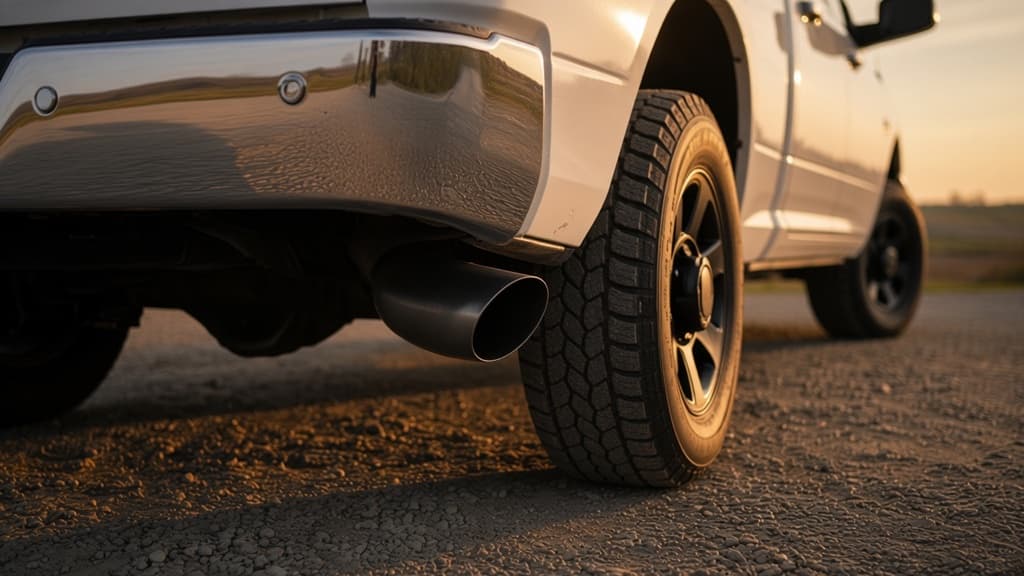
Trucks go bigger, and diesels go black. Felder's pairing advice is the clearest published: a 4-inch system takes a 6-inch outlet (7 on a big truck), a 5-inch system takes 6 or 7, and an 8-inch outlet only suits trucks with the stance and suspension to carry it. Placement is rear passenger side, "visible but not hanging way out," with the final length set by the bed, bumper, and hitch.
Finish matters more here than on cars. Felder notes that polished stainless gives the classic diesel look but shows soot and water spots, while black hides grime and is easier to live with on trucks that tow. Heat is the other truck-specific issue: keep a big tip spaced away from paint, bumper plastic, and trim, because a diesel's regeneration cycles push serious heat out the back.
Clamp-on vs. weld-on exhaust tips
Clamp-on if you might change your mind, weld-on if you won't.
| Method | Pros | Cons |
|---|---|---|
| Clamp-on | Cheap, DIY with one socket, no damage to the pipe, swappable | Needs periodic retightening; budget ones are often chrome-plated |
| Weld-on | Durable, weatherproof, sits exactly where you set it | Shop labor, hard to remove, permanently alters the pipe |
That comparison follows Trufit Exhaust's breakdown. Clamp-on doesn't mean flimsy: Corsa's Pro Series tips use a stainless clamp torqued to 45 ft-lbs with a 3/8-inch socket. Gexhaust's advice for trucks is that clamps work if you recheck them, but larger tips are better welded. Weld-on tips like Vibrant's are sold for custom fabrication, so budget a shop visit and ask for a quote - it's usually a small job.
How much do exhaust tips cost?
About $27 to $415 per tip at September 2026 list prices. The ladder, from the brands' own stores:
| Tier | Example | Price (September 2026) |
|---|---|---|
| Budget stainless | XFORCE universal tips | $27 to $165 |
| Weld-on T304 | Vibrant Performance | $55 to $96 |
| Premium clamp-on | Corsa Pro Series | $160 to $349 |
| Premium polished | MagnaFlow (3" round to 2.5 x 7.75" rectangle) | $128 to $413 |
| Carbon fiber | MBRP T5170CF dual 3.5" | $235 list, $190 on sale |
Multiply by the number of outlets. A quad setup in premium tips can pass $1,000 before labor - which is exactly why it's worth seeing the finish on your car before ordering four of them.
Are exhaust tips legal?
The tip itself, yes. Where the exhaust exits is what states regulate. A tip is a cosmetic part fitted after the catalytic converter, so it doesn't touch emissions equipment. MBRP's compliance page cites a December 1999 CARB statement that modifications downstream of the converter don't need an exemption, provided no sensors are relocated, and lists tips in that category alongside cat-back systems.
Exit location is a different matter, and it varies by state:
- California: Vehicle Code 27152 says exhaust gases "shall not be directed to the side of the vehicle between 2 feet and 11 feet above the ground."
- Maryland: inspection rule COMAR 11.14.02.06 rejects a vehicle if the tailpipe doesn't exit beyond the side or rear of the body, or if the end is pinched or obstructed.
In practice, that means a tip swap in the factory location is a non-issue, while turn-downs that end under the car and side exits are the setups to check against your state's inspection rules first.
How to pick exhaust tips you won't regret
Decide with your own car in the picture, not a product photo. Every tip looks good on a white background. Whether a 4-inch burnt tip looks right in your valance, against your paint, next to your diffuser is a different question - and the honest answer is sometimes "too big" or "wrong color." The same logic applies to rim colors: small parts, big visual consequences, and returns are a hassle once something's been clamped to a hot pipe.
So look first. Upload one photo of your car to VizTunr's free demo and see exhaust tips rendered on it photorealistically in about a minute - chrome, black, carbon, burnt, single or quad. It's the same virtual try-on exhaust and tuning shops use so customers can say yes to a finish before anyone picks up a wrench. If you're still choosing the car itself, our best cars to modify ranking is the place to start. No account needed.
ExhaustExhaust TipsBlack Exhaust TipsDual Exhaust Tips
September 21, 2026 · 17 min readCategory: Exhaust