Americans spent over $3 billion on suspension products in 2025, per SEMA's 2026 market report - and for everyone whose goal is a lower, sharper car rather than a lifted truck, that money funnels into one fork: lowering springs for a few hundred dollars, or coilovers for a few thousand. The internet's answer is tribal. The manufacturers' own documentation is more honest, and it's what this guide is built from.
Here's what each actually is, the real 2026 prices, the damper-mismatch problem that Eibach and Bilstein themselves design around, and a decision rule that doesn't require joining either tribe.
What are coilovers?
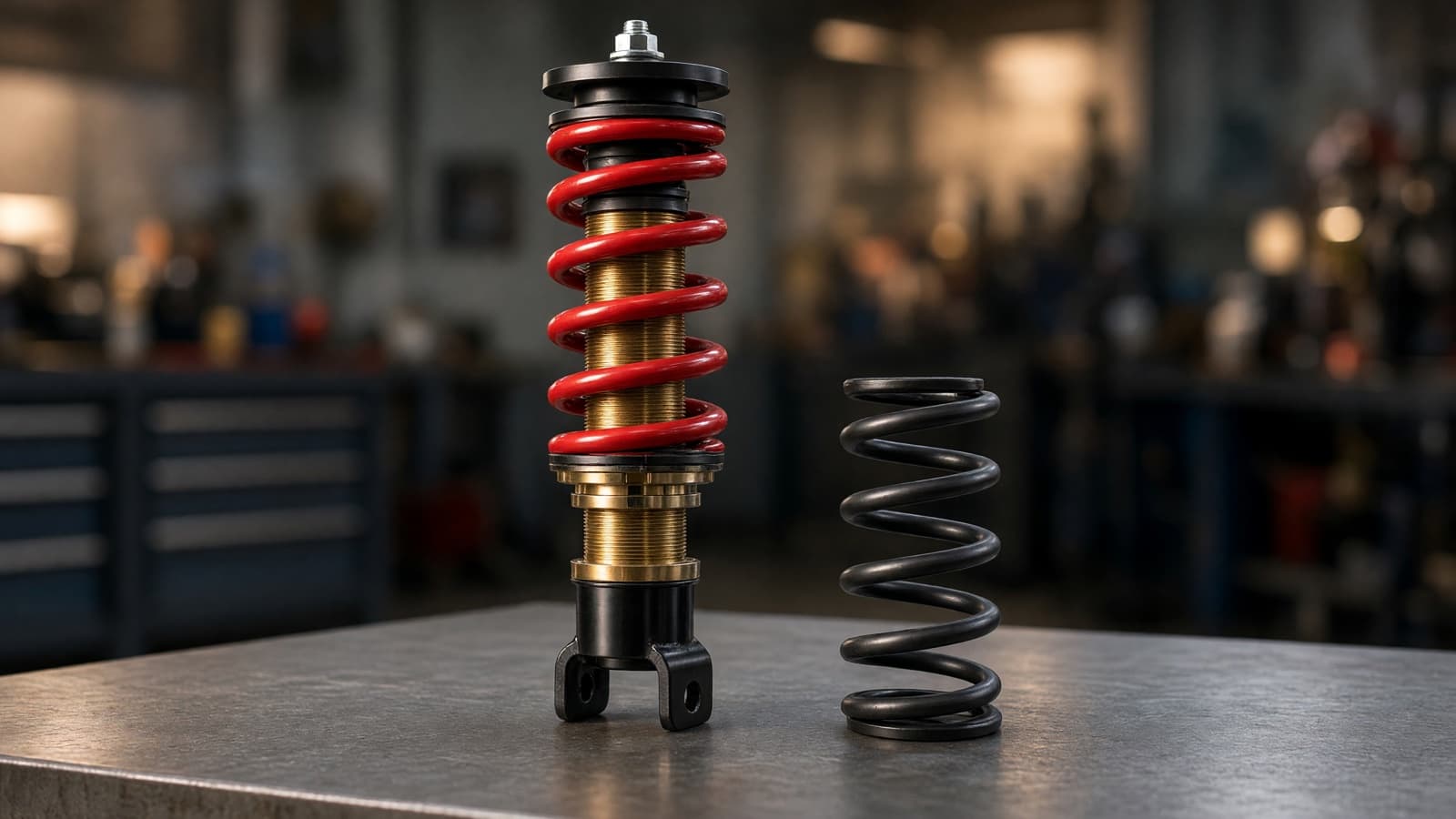
A coilover is a matched spring-and-damper unit, built as one adjustable assembly. KW's own definition captures the philosophy: coilover kits "with matching springs, dampers, and elastomer spring elements such as bump stops" are "always developed specifically for each vehicle." The signature feature is the threaded damper body - spin the spring perch and the car's ride height moves with it.
Adjustability comes in tiers. Entry kits like the KW V1 adjust height only, with damping "perfectly matched to your vehicle model right from delivery." Mid-tier kits add damping control - BC Racing's BR series offers 30 clicks of simultaneous compression and rebound. At the top, the KW V3 separates the two: 16 clicks of rebound, 12 of compression, tuned independently - while Öhlins' Road & Track kits pair adjustability with the DFV valve that firms the car for the track without ruining the commute.
What are lowering springs?
Aftermarket springs that drop the car on its factory-style dampers. They're the volume play of the suspension world - H&R calls its Sport Springs its number one selling product, crafted from 54SiCr6 spring steel and shot-peened for fatigue life. The drops are modest by design: Eibach's Pro-Kit publishes 1.0-1.5 inches, H&R quotes 1.5-1.8 inches on average, with per-application variation (a BMW F30 kit, for instance, drops the front more than the rear).
Street spring kits are almost universally progressive - the coils compress at different rates, staying soft in daily driving and firming under load, which is exactly how H&R justifies the design: "superb ride quality and comfort." Race springs are the opposite - Eibach's ERS coilover springs chase "the most linear spring characteristic" so the car behaves predictably at the limit. That split tells you what each product is really for.
The damper mismatch: the argument that settles most cases
The case against springs-on-stock-dampers is made by the spring manufacturers themselves. Eibach's Pro-Damper page states it plainly: lowering a vehicle on stock dampers reduces the piston's travel, forcing reliance on the bump stops "in extreme cases… to prevent the shock from bottoming out" - which is why Eibach sells a damper "optimized for use with lower height springs." Bilstein built an entire product on the same logic: the B12 kit pairs shortened B8 dampers with matched Eibach springs to create "a perfectly synchronised complete suspension." And as retailer Shock Surplus summarizes the valving half: factory shocks "are not valved to cope with the increased spring rate" of lowering springs.
Read that carefully and the vs-debate reframes itself. Nobody disputes that springs on healthy stock dampers work - millions of cars run them. The manufacturers' own engineering says it's a compromise on travel and valving, which is why the matched-kit middle path (B12, Pro-System) exists at all.
What do they actually cost in 2026?
Springs are a $300 decision; coilovers run $1,200 to $4,500. Live prices, August 2026:
| Product | Type | Price |
|---|---|---|
| H&R Sport Springs (BMW F30) | Springs | from $270 |
| Eibach Pro-Kit (Mustang GT) | Springs, progressive | $395 |
| BC Racing BR (BRZ/86) | Coilovers, 30-click | $1,215 |
| Bilstein B14 (BMW E46) | Coilovers, height-adjustable | $1,299 |
| KW V1 (MK7 GTI) | Coilovers, height-adjustable | ~$1,654 |
| Öhlins Road & Track (Miata) | Coilovers, DFV | ~$2,700 |
| KW V3 | Coilovers, 16R/12C clicks | $2,724-4,549 |
Whichever fork you take, add one constant: H&R's technical guidance - "alignment should be checked after any suspension ride height modification" - because lowering moves your camber whether you asked or not. A four-wheel alignment runs about $135 at national chains.
What coilovers can do that springs never will
Three capabilities justify the multiple. First, range: where springs commit you to one drop forever, KW's V3 adjusts up to 80mm depending on application, and BC's BR kits span from 1 inch below stock to a full 2.5-3 inches - you can run sensible in winter and low for show season. Second, damping tuning: dial the car firmer for a track day, softer for the road trip. Third, corner balancing: because each corner's perch moves independently, a shop can equalize the weight on all four contact patches - the setup step behind every seriously driven car, and physically impossible with fixed springs.
One paperwork note for quality-signal shoppers: KW ships its street kits with a German parts certificate (Teilegutachten) - component-level certification for road use, the same regime we saw with H&R's spacers. As always, that's certification of the component, not a blanket approval sticker.
So which should you buy?
Match the hardware to the honesty of your use case. The unglamorous decision rule:
- You want a mild, permanent drop on a budget → quality progressive springs ($270-400), ideally on healthy dampers - or split the difference with a matched kit like Bilstein's B12 that solves the travel-and-valving compromise outright.
- You want adjustability, track days, or a specific stance → coilovers, sized to your ambition: height-only (V1/B14) for looks and simplicity, click-adjustable (BR, V3, Öhlins) when you'll actually tune it.
- Warranty reality check: Eibach backs its springs with 5 years (the famous "Million Mile Warranty" is retired - it survives only in old URLs), while entry coilovers like BC carry 1-year defect coverage. Springs are the low-risk purchase in more ways than one.
See the drop before you commit to it
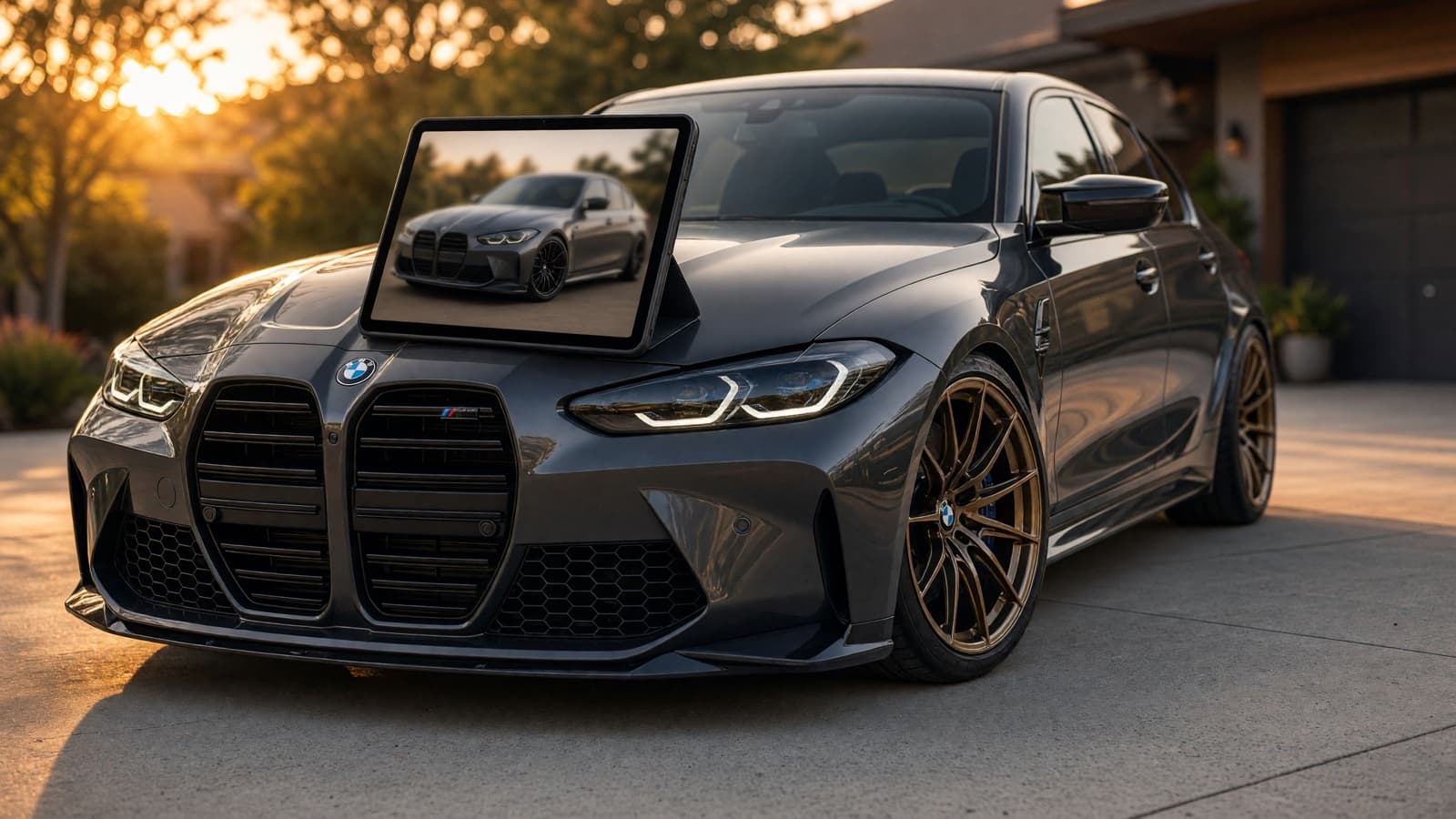
Every option above ends at the same visual question: how low looks right on your car? An inch is invisible in a spec sheet and dramatic in a fender gap - and the difference between a 1.2-inch spring drop and a 2.5-inch coilover slam is the difference between clean and full shakotan. That's a decision for your eyes, not a product page.
Upload a photo of your car to VizTunr's free demo and preview the stance - drop, wheels, fitment - rendered photorealistically on your actual car in about a minute. It's the same virtual try-on technology tuning shops use to settle "how low should I go?" before the springs are compressed and the alignment is paid for. Pick the look first, then buy the hardware that achieves it. No account needed.
TuningCoiloversLowering SpringsSuspension
August 24, 2026 · 8 min readCategory: Tuning
Explore related