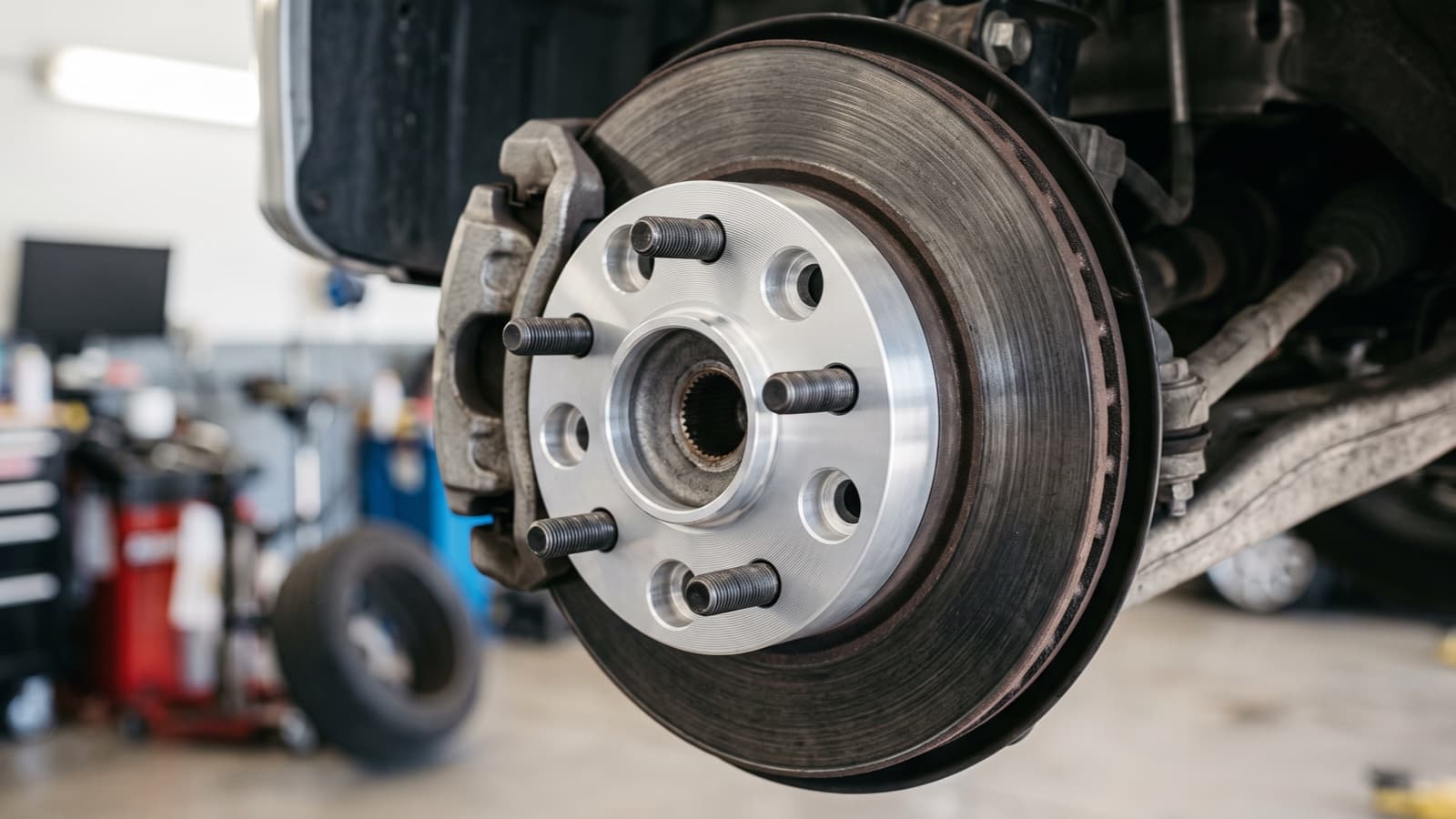
Tilted wheels split the car world into two camps. To suspension engineers, negative camber is a grip tool measured in fractions of a degree. To the stance crowd, it's a visual statement measured in how much fender clears the tire. Both camps are talking about the same number - the angle your tire leans, viewed from the front of the car.
This guide covers the whole spectrum with sources from both worlds: what camber actually is, why racecars lean their tires in, where street settings should live, how camber gets adjusted, and the onikyan and stretched-tire culture at the far end of the dial - including what a tire's approved rim range and a national vehicle inspectorate actually say about it.
What is camber on a car?
Camber is the inward or outward tilt of the tire and wheel, viewed from the front of the vehicle. That's Les Schwab's alignment definition: top of the tire leaning toward the car is negative camber, leaning away is positive, dead vertical is zero. As Les Schwab puts it, "cornering performance is directly related to your vehicle's camber angle" - which is why it's one of the three numbers (with caster and toe) every alignment sheet reports.
Why do racecars run negative camber?
Because cornering ruins a vertical tire's contact patch - and negative camber pre-pays for it. Huibert Mees, the suspension engineer behind the Ford GT and Tesla Model S chassis, explains the mechanism at The Autopian (April 2025): when the body rolls in a turn, the loaded outside tire tips toward positive camber and its contact patch shrinks exactly when it's carrying the most load. Static negative camber cancels that out, so the tread sits flat mid-corner. There's even a bonus: cambered tires generate "camber thrust," a force that helps push the car into the turn.
Veteran race engineer Mike Kojima makes the same point more bluntly at MotoIQ: under hard cornering an upright tire "is practically rolling over," wasting up to half its contact patch. And the payoff is measurable - Grassroots Motorsports' instrumented test of camber settings found a test car's four-lap average dropped by nearly a full second at -2° versus the baseline.
How much negative camber is too much?
For the street: around -0.5 to -1.0° front and -1 to -2° rear. Those are the typical street-car figures Mees cites as the compromise between cornering grip and tire life. Track setups go further - Chevrolet's widely reported track recommendation for the Camaro ZL1 1LE is -2.7° front, and its clever Multimatic strut mounts flip 180° to add camber for track days without an alignment shop.
Past that, you're paying for looks with rubber and braking distance:
- Inner-shoulder wear. Excess negative camber loads the inboard edge of the tread; Michelin's wear guidance lists out-of-spec camber as a probable cause of one-sided and shoulder-step wear.
- Less straight-line grip. The contact patch you angled for corners isn't flat for braking and acceleration - Tire Rack's alignment guidance recommends only modest negative camber precisely to preserve braking grip.
- The drag you don't see. Hunter Engineering - the company behind most alignment racks - notes that every inch of misalignment is equivalent to dragging the tire sideways 100 feet per mile, and alignment problems can cost up to 7% in fuel efficiency.
How do you adjust camber?
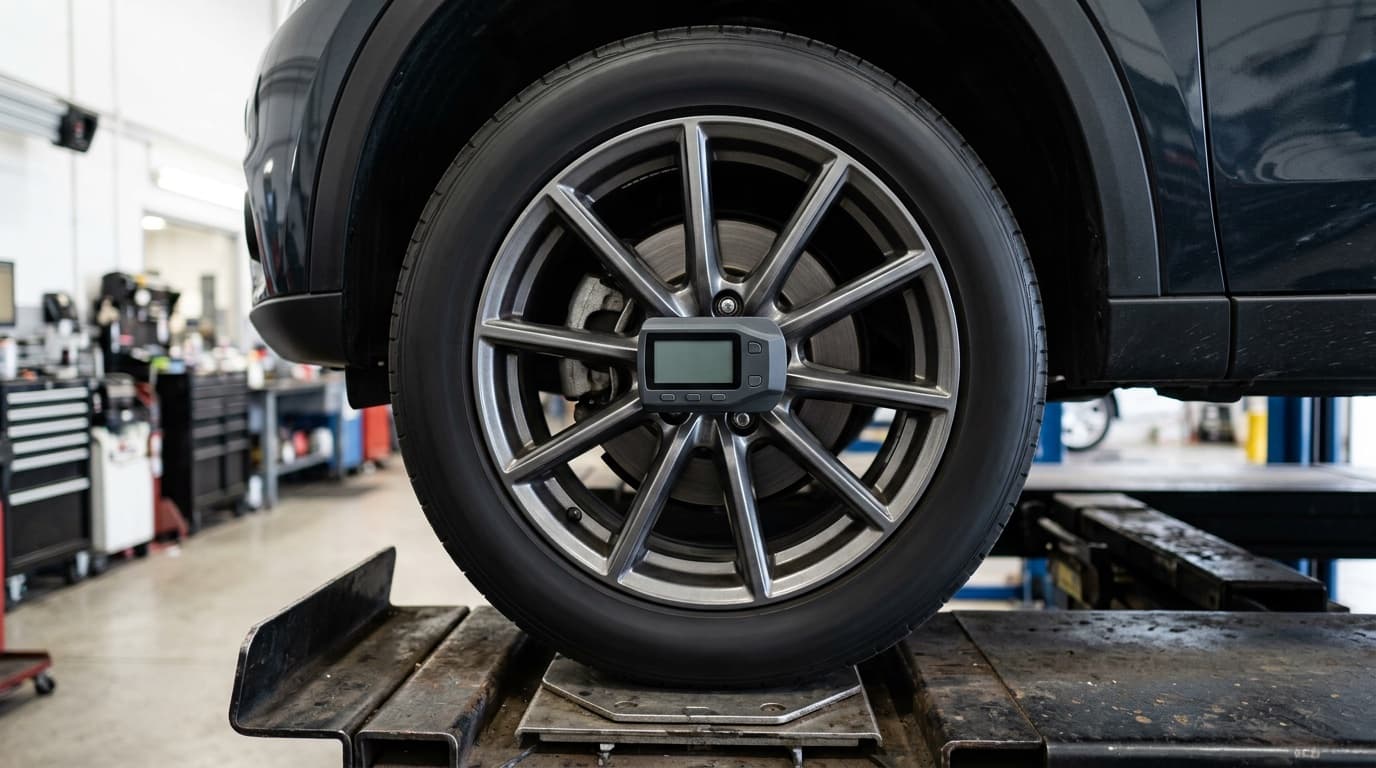
Depends on what your suspension left room for. The toolbox, from mild to committed:
- Camber bolts - eccentric replacement bolts for strut mounts; SPC's kits advertise up to ±1.75° of adjustment on struts that were never adjustable. Cheapest first step.
- Camber plates - adjustable strut top mounts that slide the strut's upper pivot inboard; the standard MacPherson-strut solution, and coilover maker KSport's guidance stresses setting both sides symmetrically.
- Eccentric cam bolts and adjustable arms - on control-arm suspensions, rotating cam bolts moves the whole arm in or out; multi-link cars take adjustable links or offset bushings.
Two practical notes. First, lowering a car adds negative camber by itself - drop it on coilovers and your alignment numbers move whether you asked or not, which is why suspension brands sell alignment kits alongside springs. Second, every one of these changes ends at an alignment rack: Les Schwab's four-wheel alignment starts at $134.99 (August 2026), the cheapest line item in any stance build and the one that decides how fast you eat tires.
Onikyan and shakotan: camber as culture
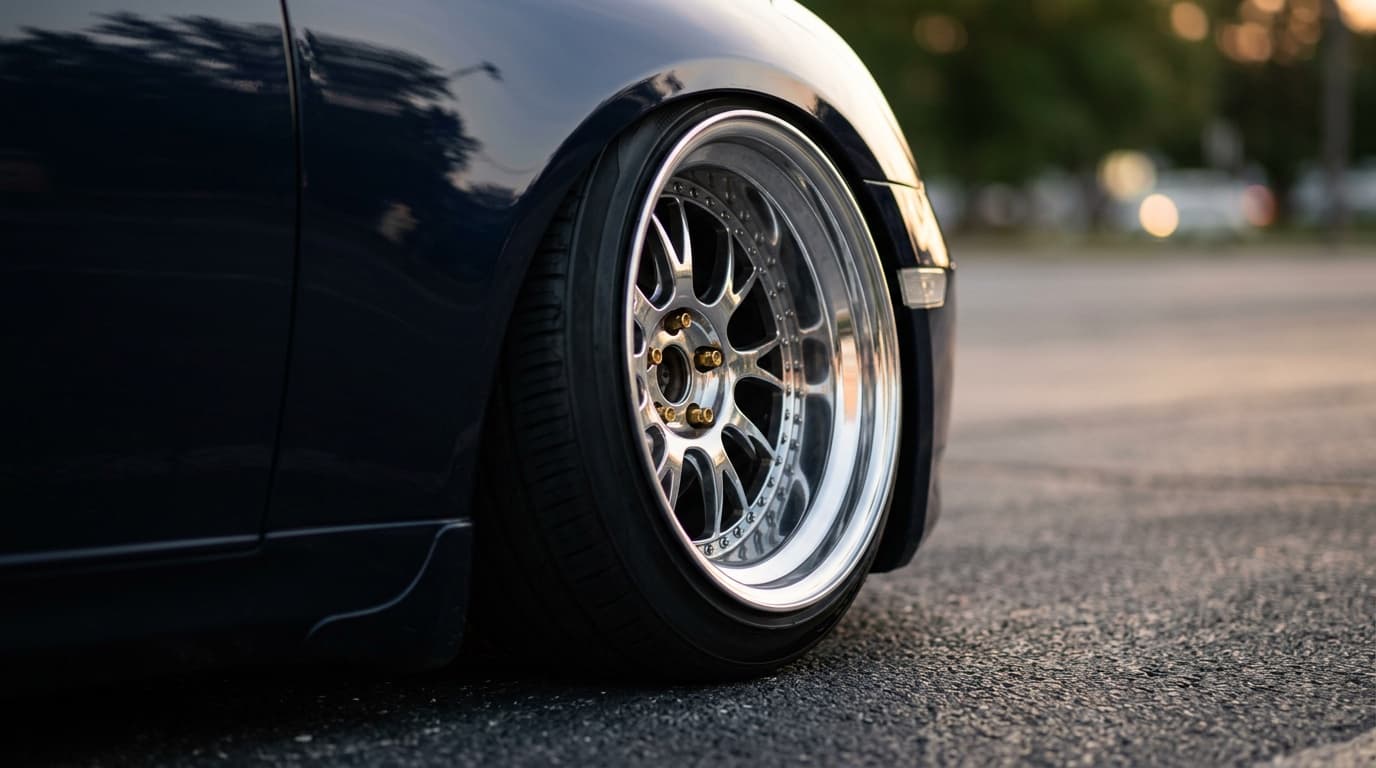
At the far end of the dial, camber stops being a setting and becomes a statement. The vocabulary comes from Japan, and it's telling that a tire manufacturer defines it best - Toyo's JDM glossary translates onikyan literally as "demon camber": extreme negative camber that is "an aesthetic rather than performance modification," rooted in drifting. It pairs with shakotan, the classic style of cars built to sit as low as physically possible. Speedhunters has documented the scene since the mid-2010s.
The honest engineering footnote, straight from Kojima: extreme camber for looks doesn't add grip - it removes it. Demon camber is fashion, and that's fine, as long as everyone's clear which camp the build is in.
Stretched tires: the stance look and the actual rules
A stretched tire (Toyo's glossary: "hipari") is a narrow tire pulled onto a wider rim, rounding the sidewall so a wide, aggressive wheel clears the fender - usually alongside camber. Whether that's within design limits isn't a matter of opinion: every tire size has a manufacturer-approved rim-width range. Tire Rack's example: a 205/60R15 is measured on a 6-inch rim and approved from 5.5 to 7.5 inches - ranges the Tire and Rim Association publishes for every size. A mild stretch can sit inside the approved window; a show-grade stretch is outside anything the tire was engineered for.
The most useful regulator statement comes from the UK's vehicle inspectorate. DVSA's guidance on stretched tires: stretch alone is not an automatic inspection failure - but a tire bead "incorrectly seated on the wheel rim" is, and it pointedly warns that owners "may find that their insurance is invalid in the event of a claim." That's the fair summary of the risk: the look is achievable, the margin for error is not what the tire's designers had in mind.
See the stance before you cut the springs
Camber sits at the end of the fitment chain: offset and spacers put the wheel where it is, camber sets how it leans, and together they decide whether the car reads as track-ready or full shakotan. The catch is that the chain is expensive to walk back - coilovers, plates, tires, and alignments are real money for a look you've only seen on other people's cars.
So preview the end state first. Upload a photo of your car to VizTunr's free demo and see the wheels, stance, and color rendered on your actual body and fender lines in about a minute - the same virtual try-on technology shops use to settle "how low is too low?" before parts get ordered. Dial the look in with your eyes, then bring the alignment printout to match. No account needed.
WheelsCamberStanceFitment
August 5, 2026 · 9 min readCategory: Wheels
Explore related