Cat-back, axle-back, downpipe: three names for three different chunks of the same exhaust, and the difference decides what you'll hear, what you'll gain, what you'll pay, and whether your car stays legal. Product pages blur them together. This guide doesn't.
The short version: an axle-back changes the sound, a cat-back changes the sound and a little of the power, and a downpipe is a tuning part that does almost nothing until the ECU is told about it. The catalytic converter is where the legal line runs.
What is a cat-back exhaust?
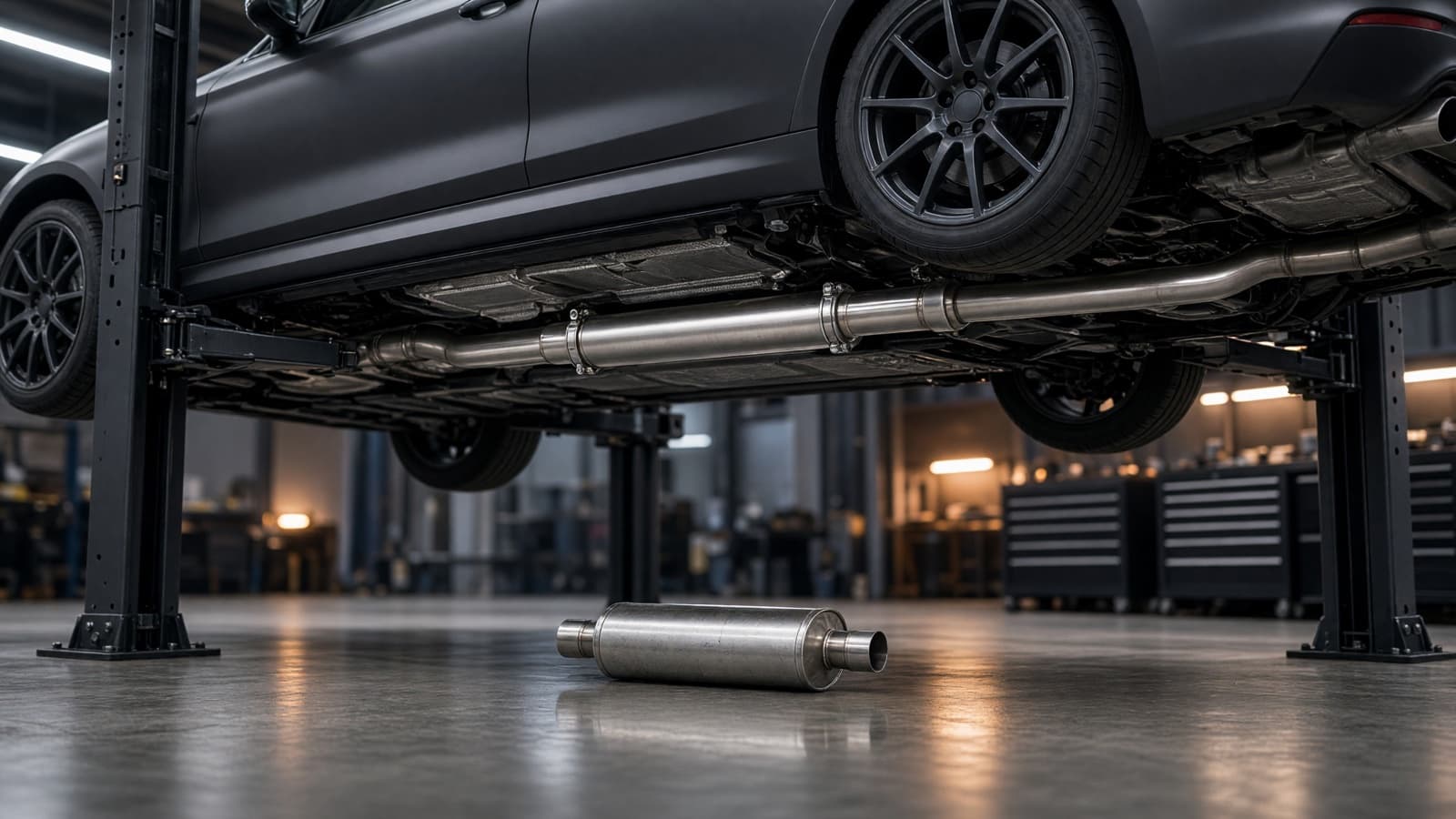
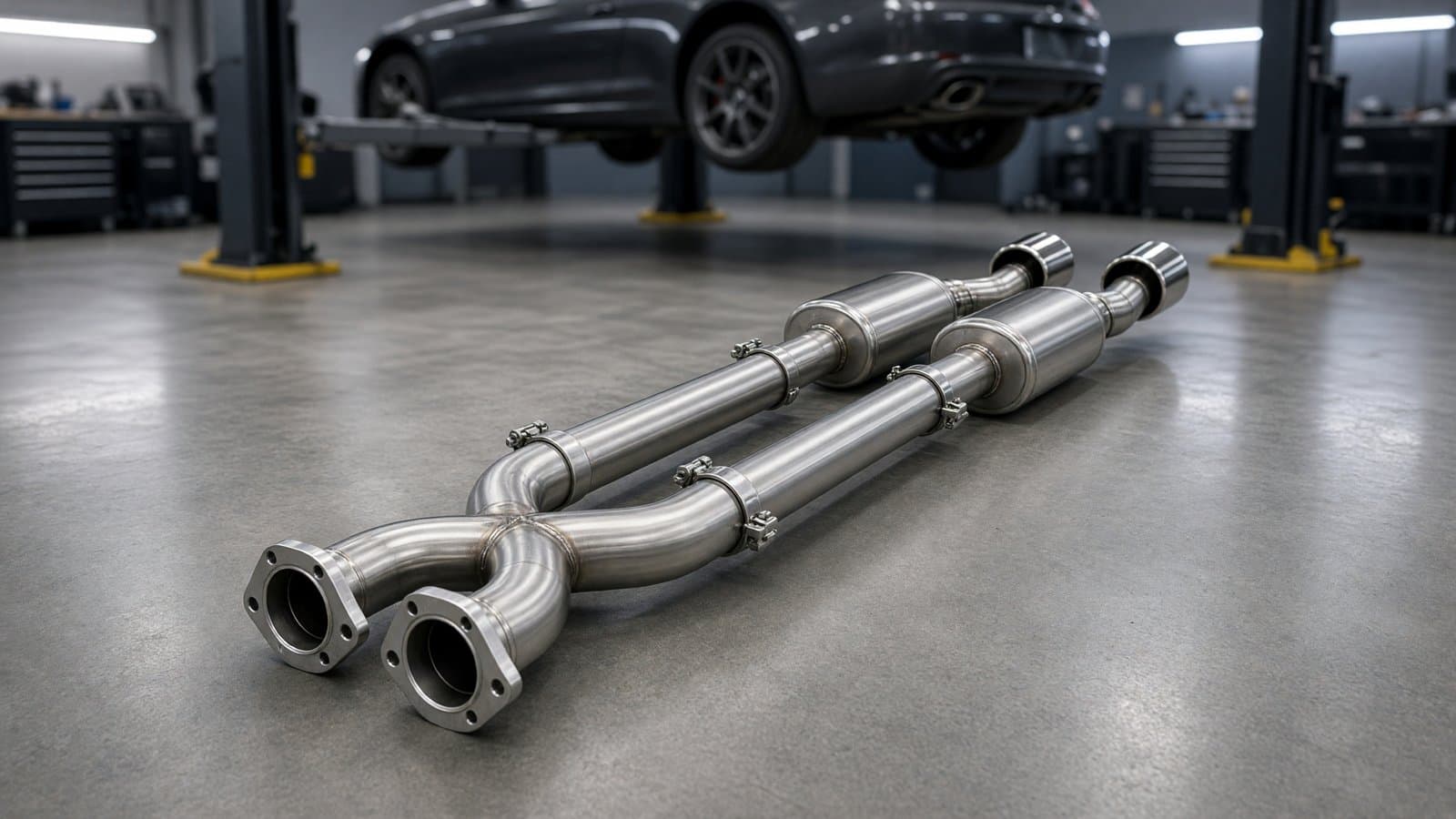
A cat-back exhaust replaces everything after the catalytic converter. MagnaFlow's definition (July 2020) is the clearest: "all of the components that exhaust gasses flow through after exiting the vehicle's catalytic converter. Typically, that includes a mid-pipe, muffler, tailpipe and tips." Because it starts after the converter, a cat-back changes sound and flow without touching emissions equipment.
Here's where each system starts and ends:
On a turbo car, the downpipe runs from the turbo outlet toward the converter, and many aftermarket downpipes include the converter itself (or delete it, which is where the trouble starts). On a naturally aspirated car there's no downpipe in this sense; the exhaust manifold or headers feed the converter instead.
Cat-back vs. axle-back exhaust
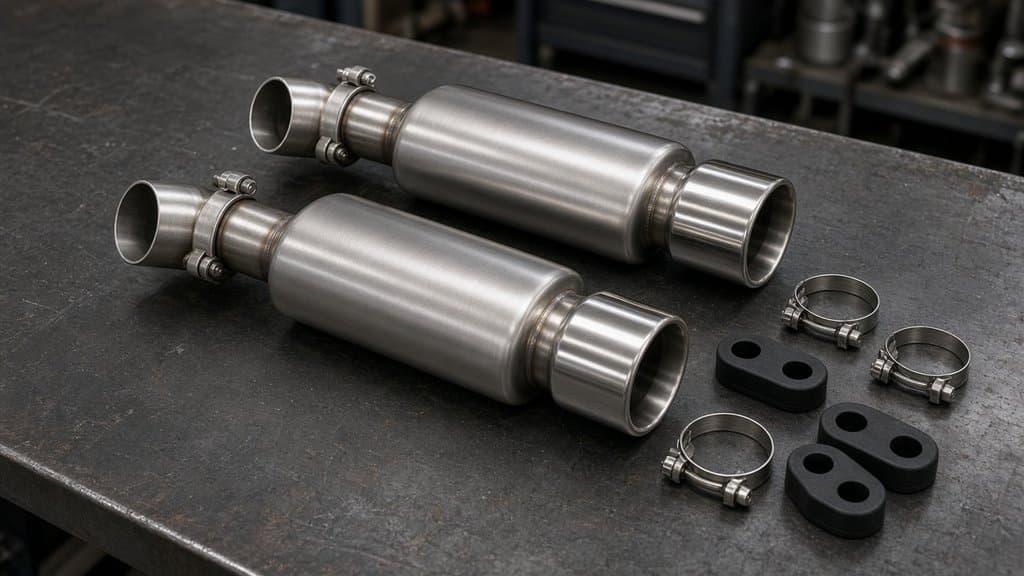
An axle-back is the sound-only version of a cat-back. MagnaFlow's same guide defines the axle-back as "the parts after the rear axle of a vehicle, which usually consists of the muffler, tailpipe and tips," and says axle-backs focus on sound while cat-backs aim at sound and performance. Both are bolt-on jobs: Corsa's FAQ puts typical cat-back installs at one to two hours, and Steeda lists about 1.5 hours for a MagnaFlow Mustang axle-back.
| Axle-back | Cat-back | |
|---|---|---|
| Starts at | Behind the rear axle | Catalytic converter outlet |
| Replaces | Mufflers, tailpipes, tips | Mid-pipe, resonators, mufflers, tailpipes, tips |
| Main effect | Sound and looks | Sound, flow, weight, looks |
| Mustang GT example | MagnaFlow Competition axle-back, $1,120 | Corsa $2,142 (sale) to MagnaFlow $3,801 |
| Install | Bolt-on, about 1.5 hours | Bolt-on, 1 to 2 hours |
If all you want is a different note and new tips, an axle-back gets you most of the way for less money. If you want the mid-pipe changed too, for flow, weight, or an X-pipe sound, that's a cat-back.
Does a cat-back exhaust add horsepower?
A little, and the published numbers come from the people selling the systems. Corsa claims +5 hp and +4 lb-ft for its 2018-2023 Mustang GT cat-back, with 48% more flow and 4 to 9 lb saved, and its FAQ says Corsa systems average a 3-5% horsepower gain without a tune. Neither page gives dyno conditions. MagnaFlow calls its systems "dyno-proven" without printing numbers. We couldn't find an independent before-and-after dyno test that loads.
So treat a cat-back as a sound and weight upgrade that may add a few horsepower, not as a power mod. On a naturally aspirated V8, that's an honest trade. On a turbo car, tuners look further upstream, at the downpipe.
Drone and valved systems
Corsa defines drone as "the low frequency sound waves generated by the engine," the boom that fills the cabin at a steady cruise. Manufacturers fight it two ways. Corsa tunes its systems to cancel drone and sells them in Xtreme, Sport, and Touring sound levels. Others use valves: MagnaFlow's SPEQ system for the Civic Type R includes an actuated valve and promises "a quiet cabin," and its Silverado system uses a passive valve. If your car is a daily driver, the sound level and the valve matter more than the peak horsepower claim. Our muffler delete guide covers the drone math in more detail.
What is a downpipe, and what does it do?
A downpipe is the exhaust outlet from the turbocharger, and it's a tuning part. Mishimoto's engineering notes on the Camaro 2.0T explain the logic: "If you can flow more exhaust gases, the turbine can spin faster, leading to more boost." The factory pipe on that car necks down from 3 inches to 2.25, a restriction a larger downpipe removes.
The catch is that the engine computer has to use that extra flow. Mishimoto's Fiesta ST testing found that adding a downpipe on the stock tune "did not show any gains in power," and the company states plainly that "a tune will be required." With a tune, the numbers move:
- Camaro 2.0T: Mishimoto measured average maximum gains of 7 hp and 10 lb-ft with its high-flow catted downpipe.
- Mustang EcoBoost: a downpipe plus intake plus tune reached about 305 hp and just under 400 lb-ft on Mishimoto's Dynapack, a reported gain of 22 whp and 118 wtq. Mishimoto adds that output "is going to depend very heavily on the tune in use."
That's why a downpipe is the defining part of a stage 2 tune: the hardware and the ECU tune are bought together.
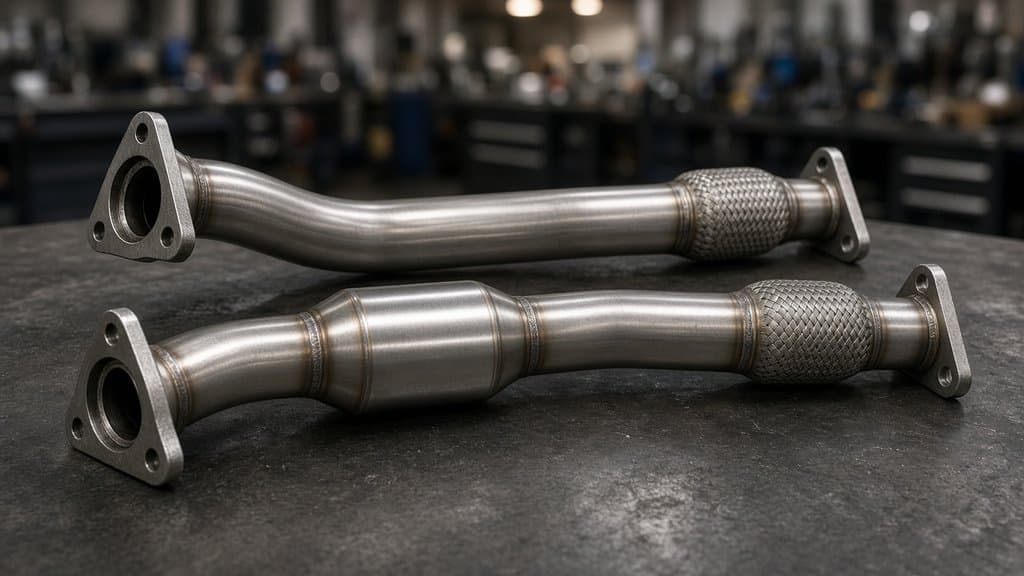
Catted vs. catless downpipe
A catted downpipe keeps a high-flow converter; a catless one deletes it. Only one belongs on a road car. In Mishimoto's EcoBoost testing the two made "relatively similar" power, which undercuts the main argument for going catless.
The check engine light is the other difference. The engine computer watches the converter with an oxygen sensor behind it, and if that sensor sees no difference across the converter, it flags a fault. Retailer Vero Motorsport (June 2026) sums it up: catless pipes "will almost always trigger a light," while high-flow catted pipes "often" avoid one, "though not all." Mishimoto's own Camaro catted downpipe triggers a light and needs a tune to clear it.
Is a cat-back exhaust legal?
Cat-backs and axle-backs: generally yes. Catless downpipes: no. The line is the catalytic converter.
- After the converter: MBRP's compliance page quotes CARB's 1999 position that "exhaust system modifications made downstream of the catalytic converter do not require a Vehicle Code Section 27156 exemption if the vehicle does not use a back pressure exhaust gas recirculation (EGR) valve, and no sensors are relocated." That covers cat-backs and axle-backs. Corsa notes CARB status still varies by product, so check the listing for your car.
- Noise still applies: California's Vehicle Code 27151 treats 95 dBA or less as compliant for vehicles under 6,000 lb. A legal cat-back can still be an illegal one if it's loud enough. Our muffler delete guide quotes the muffler laws of six states.
- Removing the converter: the EPA states that the Clean Air Act "prohibits tampering with emissions controls, as well as manufacturing, selling, and installing aftermarket devices intended to defeat those controls," and reports 172 civil cases and $55.5 million in penalties from 2020 to 2023. In California, even a replacement converter needs a CARB exemption Executive Order to be legally sold and installed.
If you run a shop, that last point is the one with consequences: the EPA's language covers installing defeat devices, not just owning them.
How much does a cat-back exhaust cost?
Most cat-backs for popular cars land between about $1,200 and $3,800. Prices from manufacturer and retailer pages, observed October 2026:
| System | Car | Price |
|---|---|---|
| MagnaFlow Touring cat-back | 2018-2021 VW GTI | $1,240 |
| MagnaFlow Street cat-back | 2019-2026 Silverado/Sierra 1500 | $1,400 |
| Corsa Xtreme/Sport cat-back | 2018-2023 Mustang GT | $2,142 sale, $2,289 list |
| MagnaFlow SPEQ cat-back | 2023+ Civic Type R | $2,348 |
| MagnaFlow Competition cat-back | 2024-2025 Mustang GT | $3,801 |
| MagnaFlow Competition axle-back | 2015-2017 Mustang GT | $1,120 |
What you're paying for: material
Material drives a lot of that spread. Summit's OnAllCylinders guide (January 2025) breaks it down:
- 409 stainless: 10.5-11.75% chromium, about 0.5% nickel. Magnetic, the material most automakers use, and close to a decade of life by owner reports. MagnaFlow's GTI and Mustang systems above are 409.
- 304 stainless: 18-20% chromium, 8-10% nickel. The most corrosion-resistant and the most expensive, and it may discolor from heat.
- Aluminized steel: mild steel with an aluminum-silicon coating. Cheapest, and protection is lost wherever the coating is scratched.
Titanium is the top shelf, and it's a good lesson in what weight savings cost. NLP Performance (July 2026), citing Akrapovič, puts the titanium cat-back for the 2025 Audi RS3 at 18.29 lb lighter than stock for $7,541, while a $1,795 stainless system from AWE saves 39 lb by dropping a muffler and a valve. Their verdict: "Layout beats material."
Warranty
The FTC is clear: "Your warranty stays in effect if you use aftermarket or recycled parts," and the manufacturer or dealer "must prove the aftermarket or recycled part caused the damage before they can deny warranty coverage." SEMA notes that dealers still deny claims without written explanations, and is pushing the FTC to require them. A bolt-on cat-back is about the safest mod there is on that front. A downpipe with a tune is a bigger conversation, because the tune changes how the engine runs.
Which one should you buy?
- You want a better sound and new tips: an axle-back.
- You want sound, a little power, and less weight: a cat-back, with a valve or a touring sound level if it's a daily driver.
- You have a turbo car and want real power: a catted downpipe plus a tune, as part of a stage 2 build.
- Never on a road car: a catless downpipe.
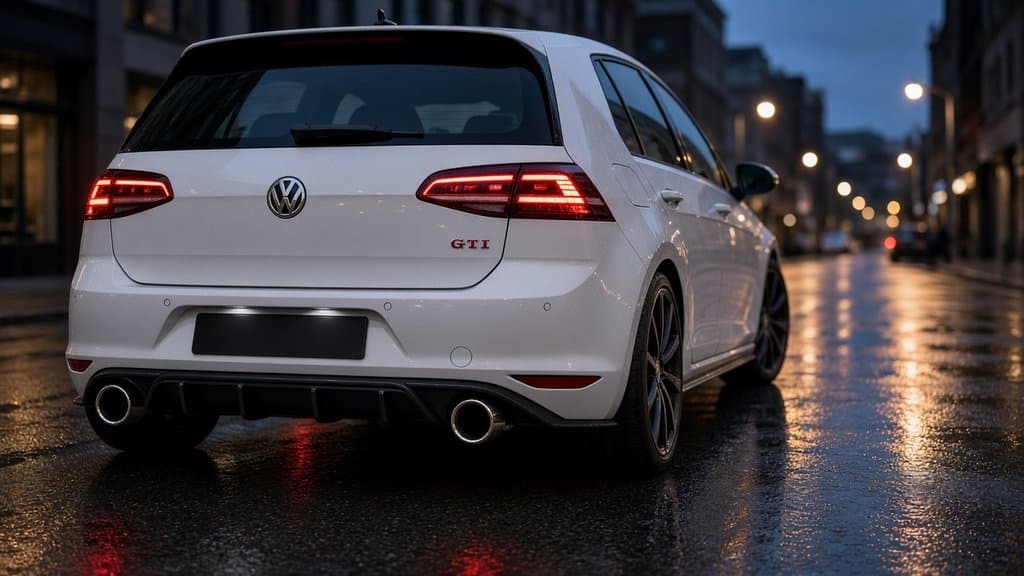
See the back end before you buy
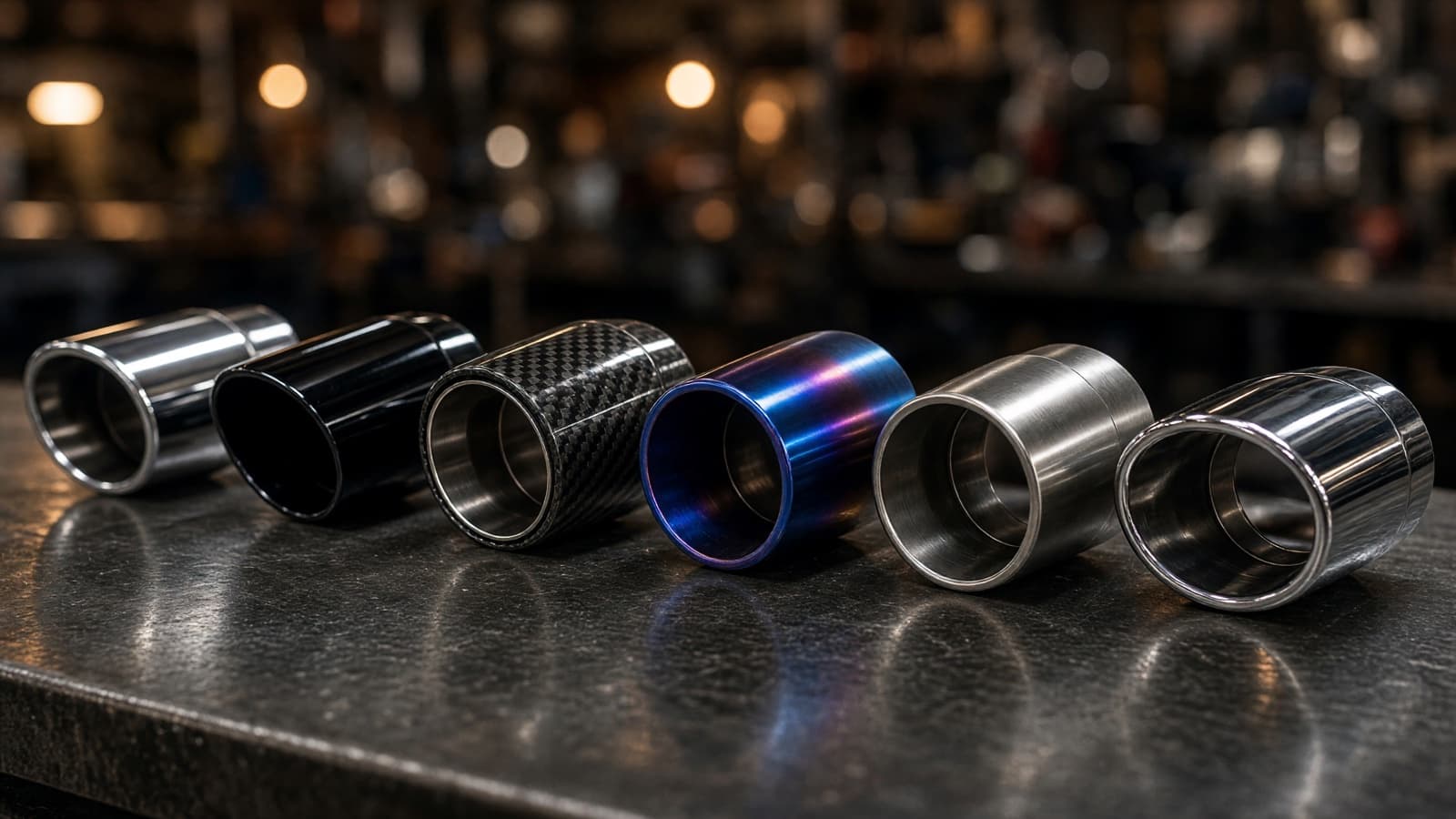
A cat-back is heard on the road and seen at the bumper. Every system above ends in a set of tips, and that's the part people judge your car by: size, finish, single or dual, and how they sit in your valance. Our exhaust tips guide covers the options.
You can see them before you order. Upload one photo of your car to VizTunr's free demo and see new tips, finishes, and the rest of the build rendered on it in about a minute. Exhaust and tuning shops use the same virtual try-on to let customers approve the look of a $2,000 exhaust before the car goes up on the lift. No account needed.
ExhaustCat-Back ExhaustAxle-Back ExhaustDownpipe
October 1, 2026 · 13 min readCategory: Exhaust